
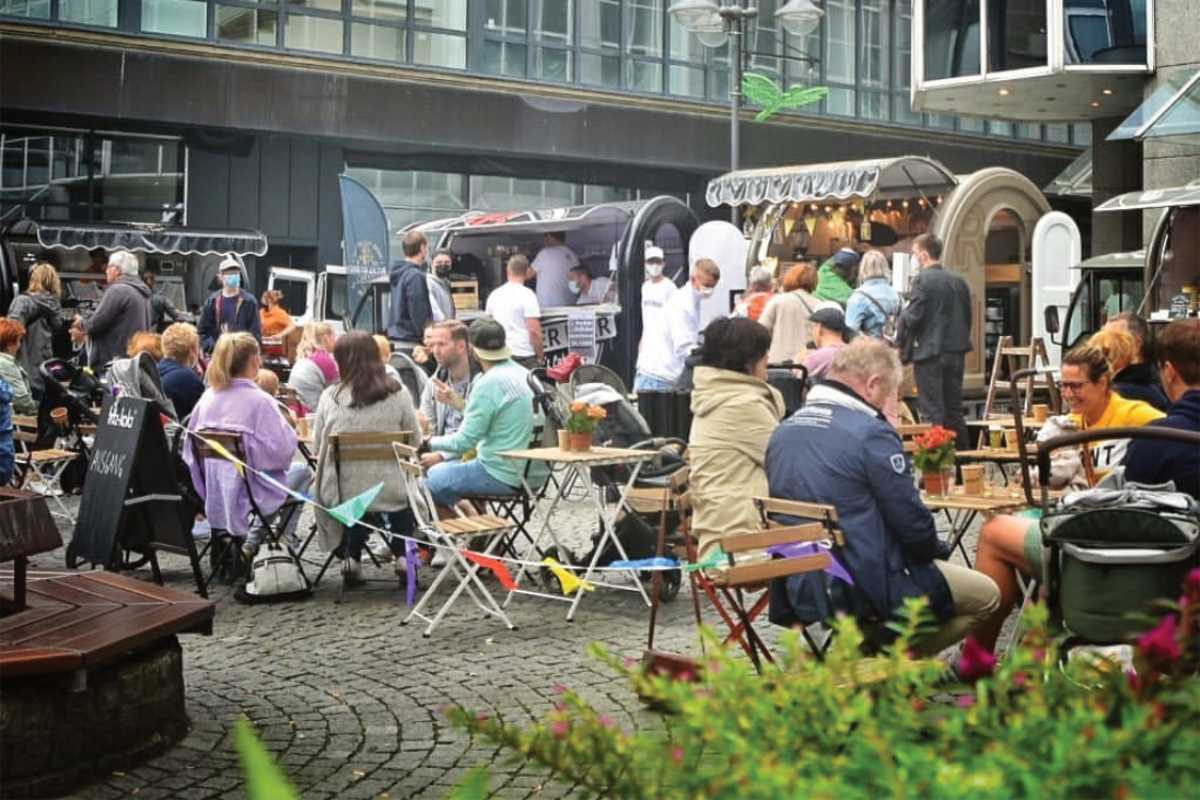
Local journalism needs to be close to the people. Community-centered local journalism even more so. It’s no coincidence that RUMS in Münster has its newsroom in a shop in the city center, tsüri.ch ran a bar during the summer, and CORRECTIV set up a pop-up newsroom in Bottrop to investigate the local pharmacy scandal.
CORRECTIV publisher David Schraven was a guest in one of our beabee Lunchbreaks, but he didn’t talk about CORRECTIV – instead, he spoke about the Marktviertel in Bottrop. This is an initiative to revitalize Bottrop’s city center, in which David and other collaborators are involved. At the heart of all activities is a coffee stand where the community comes together. This newsletter explains why such a space can be a game changer for community newsrooms.
About the Marktviertel:
- The Marktviertel is an initiative by Bottrop’s shopkeepers, restaurateurs, and local activists.
- Its goal is to revitalize the city center around the Bottrop weekly market.
- It all started with a coffee stand that operates on Saturdays at the market.
- Meanwhile, there is also a small kiosk selling coffee beans and decor, and several events have taken place, such as a documentary cinema or a music festival.
- From this initiative, the Marktviertel-Briefing emerged – a weekly newsletter by David Schraven – which is now being expanded into a new local media outlet for Bottrop.
A Physical Space as a Meeting Point for the Community:
- The Marktviertel demonstrates how important it can be to provide the community with a physical space.
- People can meet and exchange ideas there, making it easier to unite around a shared concept. A central location helps reinforce your mission.
- Community-centered local media, in particular, can signal openness, transparency, and accessibility through a physical space.
From Coffee Stand to Newsletter Media:
- The central meeting point for the Marktviertel community is a small coffee stand.
- The coffee stand operates every Saturday at the Bottrop weekly market.
- Why coffee? “Coffee is the best drink to bring people together. It’s consumed in every culture, from cheap espresso for one euro to elaborate specialty drinks,” says David Schraven.
- The goal of the stand is to enliven the streets and shops around the weekly market, attract people to the city, and invite them to linger.
- From this basic idea, several other projects emerged, including the Marktviertel-Briefing.
- Because the entire community comes together at the coffee stand, it regularly provided starting points for journalistic investigations and reporting.
- “If you stand at the coffee stand as a journalist for two hours, you know almost everything that’s happening in the city,” says David Schraven. “You’re right in the middle of things. By now, it’s become a kind of office hours.” This access to sources inspired the idea of the Marktviertel-Briefing.
- The Marktviertel-Briefing is now a weekly newsletter reporting on the development of the city center.
- Currently, the briefing has around 1,000 subscribers. Next year, it will become a paid product, enabling its professionalization and expansion into a new local media outlet for Bottrop.
Key Learnings
- Community First: The focus of the Marktviertel initiative was first to revitalize Bottrop’s city center together with a community – bringing people together around a shared idea. Only in the second step did the idea emerge to build a new local media outlet reporting on the city center’s transformation. First came the community, then the journalistic product.
- A Physical Space Opens Sources: Being physically present as a newsroom gives completely different access to people and their stories. At Marktviertel, the idea for the briefing only arose because people wanted to share their stories.
- Differentiation from Competitors: Many traditional local newsrooms are housed in unremarkable office buildings or on upper floors of shopping streets. A community newsroom that offers a space for meeting and exchange automatically conveys a different image of how journalism is done and naturally sets itself apart.
- The Space Can Also Be a Revenue Source: This is true at least for the Marktviertel coffee stand, and depending on your space, other possibilities exist. For example, Bürgerportal Bergisch Gladbach offers co-working desks in its newsroom. CORRECTIV’s bookstore in Essen served not only as an event space but also as a newsroom, café, and bookstore all in one.
This case study was first published in our beabee newsletter, where we share hands-on tips and guidance on community journalism every month. Subscribe here: Sign up
Do you have your own experiences or use cases that we should include? Just send an email to svenja.schilling@correctiv.org.